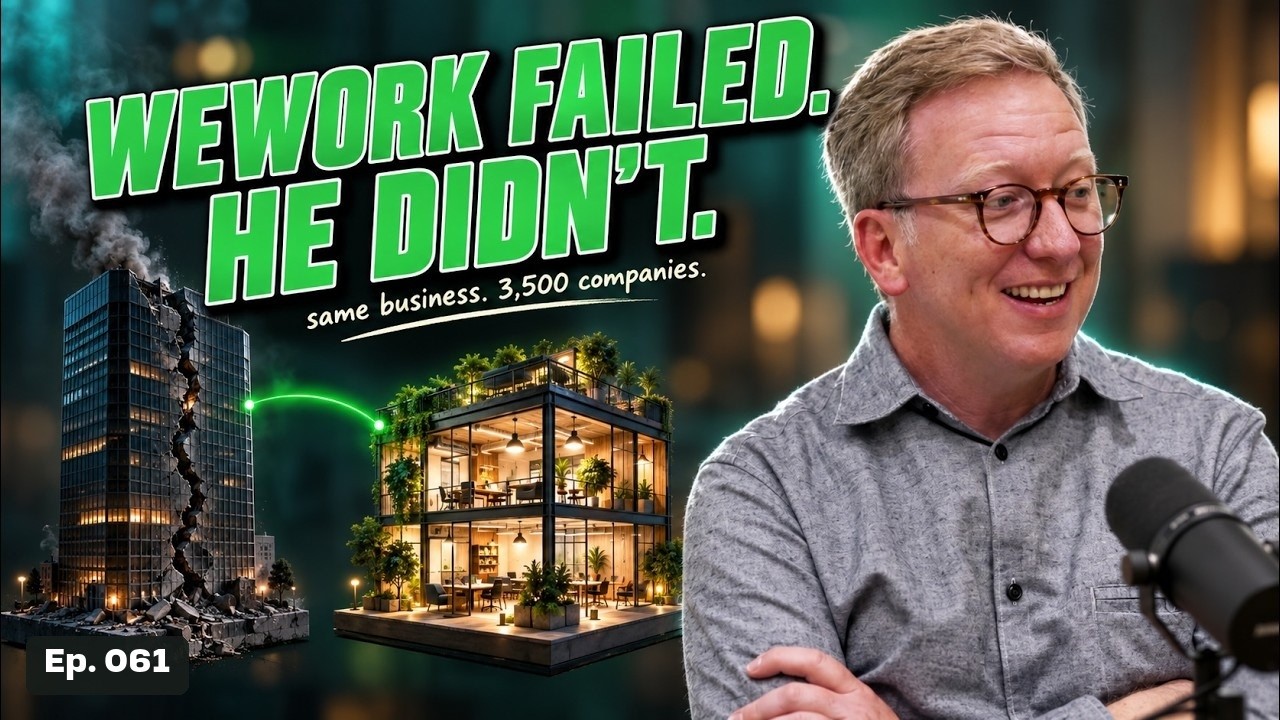
Dan Caffee tells the story of building Teem and selling it to WeWork for $100M, the startup mistakes along the way, and the devastating personal loss of his wife Elise in a tragic accident — and how it reshaped his perspective on entrepreneurship, time, and priorities.
Dan Caffee co-founded Teem (originally EventBoard), the workplace scheduling platform acquired by WeWork for $100M in 2018. Previously founded Neutron Interactive (2x Inc. 500) and JobDash. Now Founder and CEO of Voze, a sales management tool for field reps.
Show full transcript
So, we ended up it was it was over 100 million. >> Wow. >> Um, but it was all cash. Most of the tech scene is tech bros making stuff for tech bros to be honest. And that's fine. I'm I'm a tech bro, right? But why are you making stuff for startups? Broke startups that are money losing venturebacked companies. Why are you making tools for those companies? You got these massive multi-billion dollar industrial companies. >> Some new developments here. Utah family in mourning mourning the death of a wife and a mother. >> My wife and I were were going to a wedding in Mexico and a horrifying accident. and our driver was killed and uh at least was burned very badly and we ended up lifellighting her back all the way to Utah >> from Mexico. >> From Mexico. And um but it [music] was it was horrible. And she she died a few days later. [clears throat] >> Oh man. >> Don't lose sight of what's really important. What's the point of this? The point of it isn't the business. The point of it isn't that. The point of even the money. It's to use it to enrich your life. >> Right. Right. One of the key messages of it [clears throat] that really resonates now is don't wait. >> Yeah. [music] >> Yeah. >> You know, there's this tendency of like, I'll do this later. I'm busy now, but I'll do it later. I'll do it when the kids are older. I'll do it at some other time. It doesn't get easier when the kids are older. Gets harder. They're really busy. And also, life is short. And like I've been saying lately, and sometimes it's really effing short. When I found out that she wasn't gonna make it, I took the kids [clears throat] and I had to tell them and I said, "You know what? We're going to be okay." And I remember thinking, "I don't even know what that means. What do you mean, okay? How is anything ever going to be okay ever?" But I meant it. And the truth is, we're okay. [music] [music] X2. [music] >> Hello and welcome back to the Startup Ignition podcast. Thank you so much for tuning in. If you've been watching and following along, we just talked about pre-recording that people are watching every episode and going back and watching them again, which we find very intriguing. Fascinating is the right word. >> But we do have great guests. Yes, we do. But today I Yeah, we are super excited for this episode today because today in studio live in person, we have Dan Caffy who has gone way back with my dad. I know I've met you a handful of years ago and we've had multiple conversations. >> So, welcome Dan to the podcast. >> Thanks. I'm happy to be here. >> Yeah. And I'm so excited to have Dan here and hear about your journey. You've got a lot going on. I know you've had quite the seasoned entrepreneurial journey, investor, entrepreneur, and all the things that have happened to you more more recently. I'm just so intrigued to talk to you and have a conversation with you. But before that, I have a bio for Dan. And Dan, I'm not going to lie, I tked AI to write this bio for you. So hopefully [laughter] it's correct. So before we jump in, let me give the listeners a quick bio on you so they know how cool Dan is. So Dan Caffy is a founder and CEO of Vose, a Utah based startup that is revolution revolutionizing how field sales teams in heavy industries work. He's no stranger to startups though because I went all the way back here and I know that you guys talked about even going back all the way to the entice labs days where you guys initially met which was interesting but you also were the co-founder of team which was a very infamous startup here back in the 2016 to 2018 era when I was building my startup. I heard about you guys all the time. You sold that to Wei Work back in 2018. After that successful exit, you went on to do a bunch of other things. Um, which led into VO where you're at today. I know that you're a pretty prominent investor, angel investor, getting involved in very early stage with a bunch of different entrepreneurs in a bunch of different categories. Um, and I know that VO just raised a a decent amount of money. I I I read 12 million. Is that >> it was 12? >> Yeah, $12 million in a series A funding round bringing total funding to around that much or >> Yeah, total is probably 15 16 now total. Yeah. >> 15 million. So basically Dan is the Swiss Army knife. He has done [laughter] it all. Um from bootstrapping a startup to scaling it to selling it to negotiating it. Um and now doing it all over again and also investing. So thank you so much and thank you for coming on the podcast. We're super excited to have Dan. >> How lucky are we? >> Very lucky. So yeah, that's quite the bio. So um I before we get into the podcast though, Dan, I don't know if you've ever watched one of our podcasts. We are on episode 43, which seems like a lot, but we always do an icebreaker. So, uh, I like to spring something on our guests and my dad at the same time, and we do something just super fun >> and do something to relax and just get into this mood of podcasting. So, today I'm going to do a a icebreaker called Founders First. So, I'm going to ask you about a couple of memories or things that come and pop up in your head about the first time you experience something. Okay. Do you have a memory, Dan, of your very first pitch? >> Oh, absolutely. >> Well, how'd it go? >> Oh, we got some funding, but it was the worst pitch I've ever been in or seen. >> What was What was the startup? >> Uh, it was for team. So, we had spun it out of our main company. We went to go pitch uh Greg at Marcato because he was the only VC that we knew. >> Uhhuh. >> We'd never raised money and we had like a 40page deck and Greg was kind of dozing off. It was the longest pitch. It was so bad. You've never done it before. I didn't know. >> Yeah. >> And uh finally we got to the very very end and he's like >> you had one. He was like, "Okay, that piece was good. Cut the rest of it and yeah, we'll fund it." [clears throat] >> But it was Yeah, it was very very long. >> It was just lengthy. >> Lengthy, boring. We included every possible thing that maybe we could even think of. >> Yeah, it was uh >> So you bombed it, but you got the funding. >> It's cuz we were already LPS. We were already friends with them. [laughter] So it was kind of like a he would have been better off if we didn't pitch and just asked him for money probably on that. [laughter] >> Yeah. I just texted him like >> the pitch made it worse. Yeah. >> Yeah. How about you [clears throat] dad? Do you remember? >> Yep. So I bootstrap the first company. uh which was print yellow pages but then when we did internet yellow pages had to pitch that and I got kind of trained by a venture capital was helping us and there's a whole long story there but I I I'm terrible salesman and you say that about me a lot of times when I if I don't believe in something or whatever I just I can't like fake it like my wife says I'm the worst liar in the world but the but when I really believe in something and know it I just naturally organically can sell it okay and since I was going from print yellow pages launching the first ever internet yellow pages. I was able to pitch with such conviction and such knowledge of the industry that it went okay. Even though it was probably a terrible pitch from what we would standardize today, but because of founder market fit, which is a principle we really believe in, we like founders who have great market fit. I had founder market fit. So, I made it through because they could tell I knew what I was talking about. Even though venture- wise, I probably did a terrible job. >> Yeah. I I think that comes through a lot of times in a pitch is the VC or the investor that you're pitching to. can tell how passionate and how much you actually actually believe in it. Right. So that comes across. So if you're just trying to quit get a quick dollar, it it definitely communicates. >> You and I took a pitch yesterday where they super founder fit. They found an incredible problem. But on the venture side, their round size, their valuation, their plan for how they're going to spend the money, that all needed fixing. >> Yeah, that's a whole another topic. >> Yeah. If you if you have a founder who's good at the early stage, especially, >> that's really what you're looking for. Most of the other stuff's going to end up changing by the time they really get going. So, if you got a passionate founder who's who's >> really going to stick with it and they they seem to know what they're doing. >> Yeah. >> That's all they're really trying to figure. >> Yeah. Yeah. Right. Okay. Here we go. Another founder first. You ready? I wanted to switch it and say, "What's the worst pitch you've ever heard?" Not that you've given, but we'll save that for another time. >> Oh, I got that. >> I know you do. [laughter] Okay. Okay. What was your first kind of like oh crap [snorts] moment in your entrepreneurial career where you're just like this is hitting the wall, crap is hitting the fan and it's over. I mean the very first one uh it was a company and Sean Richie and I had started in the [clears throat] trucking industry and our our customer our first biggest customer was Swift Transportation the biggest trucking company in the country and they were the vast majority of our small amount of revenue but we were not even a blip on their radar and so you know we didn't have any funding or anything so we needed to get paid or we couldn't make payroll and payroll was coming up on like Friday and it was Wednesday and we hadn't gotten the check yet. And I was like, and Sean was the CFO. I'm like, you need to just fly out there and find the lady who's in charge of payable. And so he we didn't have any money. So he flew out on the cheapest flight, had his mom pick him up [laughter] at at the airport in Phoenix, drive him over there and like, you know, pick up flowers or something to take to Phyllis or whoever this lady is, and come back with a check because we got like two days away. And we're like, we don't we don't have any other alternative. We don't we don't get this money right now. >> We don't have a business. We're toast. And uh yeah, that was one of those where I'm like, I should have just gotten a real job. What am I doing? This is crazy. [laughter] But it ended up working out and and that actually happened a couple of times when >> or payroll was hard to meet. Yeah. >> Oh, yeah. Yeah. Where you're like 48 hours away from bankruptcy. >> Yeah. One time I had the proverbial my bank bounced our payroll checks. We had the money. They just made an error. Bounced all of our payroll checks. did the president of the bank wrote a letter to our employees saying it was their mistake everything but still we lost four people that said they didn't believe it they thought something was wrong with the company they left I mean yeah I mean you bounce payroll check >> well and these are start they're not getting paid that much anyway I'm not even getting that amount like I I I mean we did four people and they were good people we could not save just they didn't believe it >> okay let's let's flip this founder first what's the first time you got maybe not just a success overall, but like maybe like your first sale where you were just like, "Dude, this is clicking. This is going really good." >> I'll tell you one that was really interesting. Maybe not the very very first, but with team. >> Yeah. Just most memorable one. So team. Yeah. >> A really interesting one. So team when we first started it was just kind of a spin out of our main company and it was just kind of a skunk works to build some fun stuff and and the first thing that we built was what became event board became team >> and we just put it out on the app store. It was free and just to see. and my brother-in-law was doing sales uh for a tech company out in in the Bay Area and he called me and he was like, "Uh, I'm sitting in like the waiting room here at Twitter and they're using uh your thing." I'm like, "The calendar thing? What do you mean like Twitter? Twitter?" [laughter] >> Yeah. >> I I called Zack, my co-founder. I'm like, "They My brother-in-law says they're using our thing at at Twitter." And we didn't have any way of tracking it. And we started finding out like, yeah, people were really downloading this and using it. We had no idea. We were just screwing around for fun, just to have fun. And um it was just one of those things like those are like real companies using our stupid thing that we >> How did you not know that Twitter was a user? >> There was no subscription service yet. So it was more like anybody could download it for free. We didn't know. And he happened to just see it. They were using it there. And it was kind of a validation of like, oh, maybe we have something here, you know? And um >> yeah, it was it was it was a very cool experience. And Zach, my my co-founder, Zack Homequist, loved Twitter, you know, he users fanboying. >> Yeah. So, he was like, you know, we couldn't believe it. And then and then slowly we started finding out these other kind of bigname companies were using this stupid side project thing that we had made and we realized it was time to actually probably turn it into something real. And so that was really just seeing that put us over the edge. >> Yeah. So, like one of the aha moments like, oh my gosh, this we got a real thing here. >> Yeah. Like we made it as kind of a just kind of a joke and it turned into a a real company because of some of those moments. Yeah. How about you? >> Well, [sighs] a memorable sales moment is when uh with back to the infospace days in the in selling internet Yale pages in an enterprise way. We were one of the leaders in doing that. But we were doing small publishing partners. So, companies that would do deals that were, you know, 5,000 a month or 2,000 a month or something. And then all a sudden we got on the radar screen of all the baby bell companies, which means the Ma Bell breakup companies. And so, we did deal with US West and Ameritech deals with them. And so how much we going to charge them? [laughter] And we settled on 200,000 a month and they bought it. >> Oh my gosh. [laughter] >> Back then that's in that's in like 199899. 200,000 a month deals in and I just go what? My previous life was small potato pennies, you know, and I'm going what the heck is going on? >> But that [laughter] that tells you that no one knew what the internet was doing or the capabilities like 200,000 that's a steal. Let's do [laughter] it. Yeah. >> I mean, it was it was and doing a deal like that and write up the contract. I I'm actually helping the in our attorney draw up a contract of 200,000 a month. That's that's pretty solid. >> That's it's [laughter] a fun feeling. >> Yeah. >> Um Okay, last one and then we'll move on. Okay. How about like the first major mistake that you were like, I am never going to do that again. Like what was the first memorable mistake you ever made? I I have one that comes to mind and it and it you know it's it haunted me for years and it still kind of does actually. >> These these things do haunt you. >> So it was it was uh 2008 and I don't if you remember 2008 but um the entire world economy was collapsing. Lehman Brothers went out of business. >> Yep. >> He was just starting college career but we all the rest of us remember it. >> Very scary time for everybody. Yeah. And and I'm looking at this Dick Fold who was the the gorilla of Wall Street. He couldn't keep Lehman Brothers in business. And I'm supposed to keep my crappy startup in business somehow. I don't even know what I'm doing. >> Yeah. >> And um you know, we we lost a big biggest customer. We didn't have a lot of customers with this company. And um we had a guy that worked for us who was a great guy. He he'd been a real help, you know, to us as we were getting things going. And we were running out of money. And I waited and waited. I didn't want to make any cuts. I waited and then I kept waiting and I waited a little longer. I thought I could push it. We're going to figure it out and I waited too long. >> Yep. That's a common common thing >> because it seems like >> we saw that in 22 20 22 and 23 that's happening in our portfolio companies all the time left and right. It's a very common mistake. It's a scary thing to to deal with, especially I was I was young, you know, I was not even 30. [clears throat] >> And and this guy was our friend, you know, and so I I I realized finally I have to go do this and I was sick the night before. >> And um you had to terminate a friend. >> Yeah. And his wife was 6 months pregnant. And this guy helped us. I mean, he had helped put the floors into our office downtown in the Sweet Candy building. >> Yeah. >> He was a key guy. And um and and I [clears throat] said, "We we've got to let you go." And he kind of laughed. I think he thought we were joking. And I'm like, >> "No, like serious." >> Yeah. >> We didn't have any money to pay a seance cuz I'd waited way too long. And I said, "You you can keep your laptop. Maybe you could like pawn it or something and we'll pay for the insurance, you know, until the baby's born," which I had no idea how we were actually going to do that. We didn't really have the money to do that, but we committed to doing that. >> Um, and it was an it was just one of those experiences where your gut is just like, "Oh, man." Yeah, >> because the truth is if it's something like that, it's not his fault. It was my fault. I was the CEO. >> Yeah. >> And it was my fault that we got to that point. And I think what I learned from that was >> if you need to make that move, make it sooner rather than later. >> Um, and it's much easier to do when you can pay a severance and you can smooth things over and give him something. And when you can't, it's an awful feeling. And it should be an awful feeling. >> Yeah. Tyler tell has told a story on this podcast before that he had to do that to somebody who was a good friend of his and Tyler mentioned he Tyler cried about >> Yeah, I cried. >> I absolutely cried. >> And then after that he didn't have a car to go to drive home so I gave him a ride home for 20 [laughter] minutes in my car. >> It was pretty bad. >> I I should add to this though because this is a really interesting part of the story. This haunted me >> and that guy's a nice guy. >> Yeah. >> Yeah. I I was really worried and I thought, you know, I'm ruining this guy's life and I you know what have I done and this whole thing. Well, within like two weeks, he had gotten a job paying more than I was making for one of our customers in Virginia Beach. So, he he was living at the beach and I was still stuck in Utah with my crappy [laughter] company that was dying and he was making more than I was. >> Yeah. So, he moved. >> So, I was thinking he's, >> you know, I I was fretting over it and I was so upset. >> You freed him up. >> Honestly, I I was so upset. And in reality, it worked out very well for him. And here the other moral of the story is it worked out well for us. We were on track to be out of business. This was February. We were on track to be out of business by May. And that year, by the end of the year, we ended up tripling our biggest year of revenue and were on our way to be on the Inc. 500 for the first time. >> Yeah. >> And had we not made that move, we would have been toast. And so, it worked out amazing for me, for the company and for him. >> Yeah. >> But that lesson stuck with me even knowing how it turned out. And and I think it's it's a blessing when you have that sour feeling in your gut, which is remember what it feels like and don't push it that far. So you end up having to >> Yeah. I think the learning lesson is for all the viewers and listeners is if you have that inkling, if you feel that way, like sooner than later, just cut rip the band-aid off. Yeah. >> And it's just, this is one of the coolest stories related to that. We've told it once before, I think maybe when we had John Pastana, co-founder of Omnature on. So Omnature is a legendary company here in Utah. Sold to Adobe for a couple billion, and it's why Adobee's got such a major presence here. But in their history, they had to lay off about 40% of their entire team one week before Christmas. No severance. >> Yeah. >> And that was awful. But years later, when they had made it big, they went back and paid all those people one year severance. Can you believe that? I mean, that's that. I mean, >> Josh and John, they looked out for their investors and they looked out for their employees. And I witnessed that firsthand. And and the thing is, we'll talk about this, but you know, this this industry, this this game that we're in, it's it's a long game. >> Yeah. >> And we, you know, the relationships really matter. And I think >> there are times where there's stuff that's unavoidable. But if people know your intentions are good and that you really do have their backs, >> it you're going to come around again. And if you if you >> if they know that you're someone who who really cares about them, it will make a difference. And and I I do think a lot of entrepreneurs catch a lot of flak, right, for making those hard decisions like especially during kind of this post 2020 2021 era where things have gotten really hard and a lot of layoffs especially here in our state of Utah came around the corner like we had massive tech companies, massive brands laying off tons of people left and right doing multiple rounds of layoffs and on Reddit or on COR or on these all these forum sites there was just so much bashing of these CEOs and founders and and I get it from the employees perspective like oh I just got laid off and you know how could they do this to me but it's like as a founder and as an entrepreneur don't be ashamed of doing what's right and best by your company and if that means you know laying someone off hopefully it's like Dan's scenario where your guy goes on and has a better opportunity anyways right >> one of my experiences is I over my career some people were really upset with the decisions I made as a CEO but those people later went on to own their own business like five years later they come up and talk to me and go, "John, I need to apologize to you. I was really harsh on you when you made a decision that led to this and that that I completely disagreed with, didn't understand. Now that I've owned a business for a couple years, I've now caught myself doing the same kind of decisions and I understand exactly why you did it. So, I owe you an apology." >> Yeah. [laughter] I think one of the great things about a podcast like this is that it gives some context to people and it's stuff that I didn't have coming up. >> Yeah. >> And so, it it would feel often very lonely. >> Yeah. >> Yeah. You know, I I've always had co-founders in my companies, which is great. So, I have a partner there. Fine. Then the two of us are lonely together in this, but I I didn't we didn't know anybody else who was doing this. >> One of the best networking things you can do is [clears throat] get other CEOs that you meet with for lunch or dinner once a week or once a month. Yeah. >> I didn't have it. I didn't have it. And so, so bean and I just kind of in our bubble solving problems that had probably already been solved by lots of people. We just didn't know how. we try and read, you know, Fast Company and read, you know, business books and stuff, but um and I [clears throat] think having this context, it does make it much easier because now people understand what it's like the first word who's >> deal peer-to-peer mentoring with somebody. I always tell people, go find somebody who's about six to 18 months ahead of you in their evolution of their business and peer-to-p peer mentor with them. Take them to dinner, go to lunch with them, socialize a little with them. They they've just spent the last year with all the things you're about to do. Yeah, >> we we did have a guy who was uh he owned a very large mortgage company here. He's a good friend of ours and he was he's about 10 years older than us and about he was about 10 years further along in his career than us >> and he was kind of an early investor and partner of ours and he was a mentor for us. I mean we you know gamechanging cuz he was the only guy that we really knew who'd kind of been through it and when we'd be stuck we just call him be like Dave what do we what do we what do we do here? And he's like >> here's what I've done before. Here's three people to call. Yeah. here's a person I know and it was um you know when you're right on the edge and you're about to lose it >> and he's like >> no I've seen this before >> it's okay that's that's one of the hidden secrets of being successful there's probably very few entrepreneurs that have been successful that didn't have one of those guys in their life >> yeah and I think that's kind of the benefit of our portfolio you know with our venture fun >> we doing our venture fun >> I mean that's one of the perks of of being >> we're super available and helping with soup to nuts any thing that comes up, >> right? It's just, you know, the 30 years of pattern recognition that this guy has and, you know, the small short career that I have, too. It's just like, oh, hey, we've seen this before. >> Here's how you get from A to B. Here's how you get from B to C. >> Five times it's worked. One time it hasn't worked. So, here's what we suggest you do. Right. So, that that just experience is is a lot. Very cool. >> I think I think it makes a huge difference and and for people like >> to know you're not alone. >> Yeah. Yeah, >> cuz it feels like I'm I'm the only person who's ever done this >> ever felt this way or had gone through this. Yeah. Hundreds. >> You're not you're not the worst CEO in the world. [laughter] And if they watch stuff like this, I'm sure I mean I've already shared a few of my biggest screw-ups and I'm sure there'll be more. Well, he's pretty successful and he screwed up tons of times. >> Yeah. >> Yeah. That's part of it. So, >> Yep. >> Okay. What a great icebreaker. That was a great conversation. Thank you, Dan. But, okay, I wanna Let's go back to the beginning. Where does Dan get the entrepreneurial bug? When do you kind of set out and say, "I know I'm going to start things rather than maybe go get a career job." >> Where'd you grow up? Where did you go to high school and and then where'd you go to college? Yeah. >> So, I grew up in DC area in Maryland. >> Oh, okay. >> And um >> inside the belt. >> Yeah. Yeah. Really? In uh in Maryland. So, we grew up in like Bethesda and was in the Ptoic South Ward and Chvy Chase and and then uh Kensington. >> Wow. So yeah, that that area and my folks still live there. And um I never really cared about business at all. Actually, my dad um my dad was a was a businessman. He was an entrepreneur and um he and his partner built a a big company. They were in the industrial recycling business, which is like a euphemism for junkyards. >> Okay. >> Very successful business. I mean at the height they were probably doing a quart billion dollars a year in sales. Was very big. It's >> industry. It's industrial recycling. So, it's, you know, recycling aluminum and it's stainless steel and malibdinum and copper. Uh, and I would work there sometimes as a kid. I wasn't very good. They just let me work there because it was my net. But >> I'd get yelled at a lot. I was very bad at it. My brother was good at it. I was terrible at it. Um, but you, you know, strip copper wire. So, I worked as a stripper. >> Oh, nice. Hey, there you go. [laughter] Your claim to paint. Dan Cathy, you heard it heard first. He worked as a stripper. Okay. [laughter] But uh but so so he was an entrepreneur and and there were a few periods where he had started a couple different businesses but this one he he he joined a business and became a partner and he and his partner were they worked together I think 35 years maybe. >> Um and uh and then they sold the business a few few years ago. Um his his partner died and I think he didn't really want to do it without his partner. Mh. Um, and so they, yeah, they ended up selling it and it was a great deal. But I saw what it was like and I learned a lot from from my dad and his partner about how to run a business, how to treat employees, um, the importance of loyalty, the importance of treating people well. And there were some really important lessons. And so that's that's really where I got it from. >> Still didn't care that much about it. Uh, I wanted to I was an international law and diplomacy major at BYU. And I wanted to do something like that, be a diplomat, something like that. And uh but I started my I joined a startup really, my very first one in college. It was uh here in Provo out of a guy's basement, friend of mine, and [clears throat] I saw an ad. I I was doing tech support making like $14 an hour, which was pretty good back in like, you know, in was it I came back from my missions, I would have been 99. >> I was doing all right. >> Yeah. But I I wanted something more and I I saw an ad. They used to have a billboard down in the basement of the Wilkinson Center with stuff on it and it had one said, "Do it all for a small software company. 7 to$12 an hour." And I was like that I think I I think I want to do that instead. So I went and uh went down to to uh this to the interview. He said, "You just come around the back and go down the stairs into the basement." So, I told my roommates, "So, >> if you don't hear from [laughter] me, I'm definitely dead. And here's where I went." >> And I go down there, and it was just this this guy, uh, he's he's actually been on the council. His name's Dave Su, and he was a >> Oh, yeah. He's a great guy. And he, uh, >> he had this company. They were making some software, and I thought, "This is less money, but I'm going to learn how to build a business here." >> Um, it was wasn't much of a business. It was just a little product, but he wanted his his wife gave him one more shot to to make a go at trying to build it into a company. And so, it's >> kind [clears throat] of a Hail Mary and I joined it and we started building something and and it turned into a larger much larger company that started doing hardware importing and all this other stuff. And I I learned a lot from Dave and I learned a lot from that experience. Uh, and by the end, I was making a lot more money than I was in tech support anyway. >> And I did it for about two years and then >> moved on and that's when Sean and I started um our first company together. But, but that was my first one. And I what I realized was I'm good at this. I'm good at it and I really kind of like it. Um and from there, you know, I was always a little bit of a nerd. I know that's a shocker probably, [laughter] but uh so I I was into computers and the internet way before anybody else really was in the in the early 90s. And so I I had that experience and so I was doing internet marketing, web marketing for this thing, which nobody even knew what that was yet. Yeah. >> And I did really well with it. So then I started doing some consulting with it and I realized I think this is probably what I'm gonna end up doing for my career and it has been tech. I've been in tech ever since. Um >> so that's how I got the bug and that's how I got into it and uh I just I just tried it and it's addictive man. >> Fast growth. >> How did you So Sean Richie has been a longtime partner of yours in many different things. Is that correct? >> And um so you met him pretty early in your career. >> So I met Sean way before we had a career. So in 96 I came out to BYU and he was on my floor in Vhall of Desireette Towers at BYU. >> He was in your dorms, the now torn down Desert Towers, the earthquake hazard where you >> look like a turquoise prison >> could have been flattened like a pancake. [laughter] >> The windows were bolted so it could only open this much cuz it was like a it was literally like a prison and you had everyone was up on >> on cinder blocks. >> People don't know Desert Towers literally any slight earthquake it would have gone [laughter] and because that was the only like tall building on campus like >> Yeah, it was it was pretty bad. And and I remember walking in there and I'm like, >> "Oh, this looks just like a prison cell." [laughter] >> Prison beds. I'm like, "This is wild." Um, but we met we met that year and then we became friends. Um, and started, you know, doing stuff together and um, and then when I I went on a mission to Honduras in 97 to 99 [clears throat] and came back and we reconnected >> and um, >> so you were you you were in the same floor? >> Yeah, same floor. >> Okay, got it. And so we were just friends and then um through a bunch of circumstances you know he he had joined a startup that was that had failed >> started to fail and I'd been kind of consulting them also was in in this in between period and I went to go visit him as he was packing up kind of the office to kind of shut this thing down and I said what what about that they had a website that I'd consulted with at this startup the startup was kind of stupid but they had this website that I felt like we could maybe do something and I had just been offered a job at Park City Mountain Resort as a web marketing director. So, I was like, >> but I was waiting to accept and I went to go visit Sean and talk to him about it. He was packing up >> and I said, "What about that site? What if we just took that and built a company out of it?" And Sean had said before, I thought you were crazy. You had an offer for a real job with like benefits and stuff. We're going to start some stupid thing. >> Yeah. >> There was just something that wouldn't let me. And I'd really wanted this job. It was like, >> but it just seemed like a better idea, an opportunity. And um so we went and talked to some of the the investors that had been in the thing and we did a deal and and started a company together. >> What was that called? What was the company? It was called Driver Careers and it was a platform to to recruit truck drivers. There was a huge shortage of truck drivers. >> Um at the time there was 130% annual turnover [snorts] >> and >> like 130% annual turnover. >> Being a long haul truck driver is a it's a tough job. It pays really well, >> but like a 100% of the industry would turn over. >> Yeah. So they'd have to hire, if they needed a thousand drivers, they'd have to hire 1300. Wow. >> Because they'd lose some money because you you think, "Oh man, this is good money. I only need three weeks of training. This is amazing." Then you realize you're gone to make that kind of money. You're gone all the time to be an over the road driver. >> And so, >> and it's actually a tough job. It's lonely. You You got to be really careful about falling asleep at the wheel, right? I mean, all >> but with the technology now, it's I I still will say it's a great job for someone with very little education. you can make really good money doing it. Um, but you got to know what you're getting into. Yeah. So, we saw this opportunity. Nobody was doing anything online. They were, you know, had phone numbers at truck stops and stuff. And so, we had this website and we started really building this out and we started working with all these companies and schools, uh, you know, training schools. >> So, to recruit truck drivers, they would market at truck driver pit stops >> and and [laughter] maybe billboards and and things. And so, we we took it online and built a an applicant tracking system so we could digitally do it all. And it was it was very cool. and Jose of transforming some very old industrial >> lot a lot of the trucking companies wanted to hire drivers started using you for recruiting and fulfillment of filling positions did you also do the certification and training >> so we we didn't do the training but we we connected them with the different training companies >> okay got it >> and so we would help them and some of these companies would trade so we we ended up saying you know we we would we did tens of thousands of drivers that we brought into the industry um during this period and it was a really great company and then we expanded where we actually had outsourced recruiting where we were and using the the company when I met you, you were doing this company, but it was probably an evolution from the start, but it was named something different. >> Neutron. >> Yeah, Neutron. >> Yeah. So, we ended up selling off most >> Neutron Interactive or >> Neutron Interactive. We ended up selling off most of this trucking site a few years later. It's It's an interesting story, but we sold off most of it. >> Um, >> was that trucking company, the one that you did that deal with Swift on? Was just to recruit more drivers for them. >> Yeah. >> And we were doing the majority of their stuff. >> Yeah. And so uh we we ended up selling off the most of that and keeping the pieces that we wanted uh and did some contracts with some we sold it to one of our customers and then kept these contracts and then expanded to you know transformed. It was a big pivot. It had some of the same bones as the business but we had sold off the main piece and then we expanded and that company ended up being really big and we were on the Inc. 500 a couple of times. So that pivot was there and the story there was I I didn't really love the company. I didn't love [clears throat] a lot of our team. I didn't love our offices. I didn't love much about it. And I I remember pulling up one day to outside our office in the parking lot and I was sitting in my car for like 20 minutes and I was like, >> "Oh man, I hate this. >> I can't do this." >> You know, and I say all the time, it's it's a it's a really tough thing to have a terrible company, right? To have a terrible job. If you're the CEO, it's even worse because not only is it terrible, it's your fault that it sucks. >> I mean, who do you blame? all the stupid CEOs. It's your fault, man. It sucks. [clears throat] And I hated my own company and it was my fault. And so I remember going in that day and Sean and I sat down. We're like, what are we doing? The whole point of building your own company is to do something that you love, you know, and whatever. And like, we don't love this. What if we just sold it? So, one of our competitors who was a customer um really wanted to make a play there. So, we ended up selling off all those operations to him in exchange for a contract. And then we moved downtown to the Sweet Candy Building, which we could not really afford. Mhm. >> And decided and and did a pivot and it was one of the best things we ever did. But it even with that pivot pivot, it took a while for catch on, but that ended up becoming a very successful company and I spun team out of that company. So that was even a continuation of this. >> So um >> Neutron Interactive was that company. >> Yes. So it went from Driver Careers, we sold off Driver Careers, Drivers Agent Network, and we sold that off and then started Neutron with the pieces that we kept. Uh-huh. >> And then um and then team spun out of that. It was just >> this was Yeah, I was going to say was Neutron just kind of like a special projects thing like figure out what works. >> So Neutron was like the was we ended up being a very successful company doing very similar things just beyond just the trucking industry. It was recruitment technology company that went beyond trucking. So we did the same kind of concept but much wider >> and then as the company got really big >> really big but like at the time we were up to I think 25 million in AR like it was pretty big. Yeah. >> Very profitable because there was no venture capital so you had to be profitable or you couldn't have a company. >> And then we were on the Inc. 500 for the second time and we're like >> it was getting big. I wasn't involved in the fun stuff anymore and and I wanted to and Zach Holquist um was was an engineer there and he was a good friend and he was like I think I need to I'm going to quit because I I need to make more money. I was like he would never work on anything he was supposed to work on but he's a genius. So I was like, "Sorry, not accepted. You can't quit." And he was like, "No, I I'm I'm I'm quitting." I'm like, "No, no." And they they had 20% time to work on stuff. And he and one of um one of my other engineers, good friend Jason Bger, had had been working on some stuff with this new thing called the iPad that had come out, and they were making some apps for it. And he said, "All right, here's the deal. Let's take that stuff you're working on with the iPad, and we'll make a company out of it. You can be a co-founder, and we'll do that. It'll have a little side project, and we'll just build cool stuff. That'll be like a skunk work." >> So that's how you kept them around. was like, "Hey, we'll just let you do what you want to do, but inside our company." >> Yes. >> Because I was bored, too. I wanted a reason to write off buying cool electronics and stuff, too. I was like, "This will be fun." Cuz I was getting bored. And it was it was like a fun thing. But you know how it is when you're an entrepreneur. Those fun things turn into money-making opportunities. And so, the very first thing that they made was what became Team. We made a bunch of other things, too. >> Yeah. What did you call it before Team? >> It was Ender Labs. >> Ender Labs. >> It was just the labs. It was just a skunk works to make [clears throat] cool stuff. And we made some very cool cutting edge stuff that was, to be honest, way cooler than Team. Yeah, >> but that's the one that ended up getting a lot of traction and >> so eventually >> because the use case was so easy. It was like so tell us about >> team war then and is this so this was moving on from neutron interactive then >> it was simultaneous at first actually. >> Okay, got it. >> So I was running both of >> and where did entice labs come into play and the timing of everything? cuz yeah, I know that's where you guys kind of met too. >> And it's super confusing because we had Ender Labs and then we bought Entice Labs which yen it was crazy but >> so it was around the same time we we built this this Ender Labs and it was kind of a skunk works >> and then [clears throat] there was another company called Entice Labs and they were a partner of ours at Neutron. Yeah. >> So we'd been doing business with them and they were a good partner. They were doing some very cool things. Company wasn't great but it was a phenomenal team. >> Yeah. So Ryan Caldwell had been Caldwell CEO. Yeah. >> Yeah. And and then and I'll I'll tell you >> for those that don't know Ryan Caldwell, he's CEO of one of the unicorns in Utah, MX now. >> One of the one of the best best tech companies that Utah's ever seen. He's a >> and he's a he's a hard driving successful CEO. >> Yeah. He's he's he's incredible. And so um so what happened was that company started to to fail as startups do by the way. That's what happens. >> Yeah. Yeah. By the way, part of that story in my career, just to interject here, and the failure is it was 30 days after you acquired that that I learned about the lean startup process >> and I back tested my career. Okay. Because I was the biggest investor in entice and so I go hm knowing lean startup I would have done we would have done so many things different at entice labs. It was this is a premature scaling. Yeah. Uh you say yeah we're gonna say let's see how we can prematurely scale with abandon. [laughter] >> So >> but but the thing is we learned a lot from it. So they were a partner of ours and we needed them >> to kind of be those operations. And so when >> and you got it for >> nickel on the dollar right whatever >> nothing. And it was which was amazing. So it ended up being a great deal. So what happened was I uh somebody called and said hey the partner manager said hey entice is going down. Maybe we should do something. And I said that's great. So I called a banker friend of mine, Mike Fermage with Horizon. It was he had just started Horizon. It was the first deal they had done. And I said, I I want you to help me get this deal done. And so John had kind of stepped in as interim kind of CEO just to help figure it out. He was the biggest investor. >> And uh and there was not that many people left. There was only a couple people left, Skeleton Crew, but I needed it to >> stay together. >> Stay just just enough together that we could do this. >> And so so I met John. We engaged on this thing and we worked out a deal. And um it ended up being you know I I think whether it was financially great for entice but what it was is it took some of the dream of what entice was and allowed it to keep going >> and for us it was really important and it ended up being a great deal financially for us also but much more so than the financial deal was the relationships including my relationship with John which is why I know you. >> Yeah. Exactly. >> And this was this was 2010. >> Yeah. about 10 years ago, right? Almost >> and you know I I look back at this Caldwell is now one of the most prominent most successful CEOs and by the way this was a a big failure and he is now one of the most successful CEOs. So when you when you're so fretting about it's the end of the world it's not the end of the world. >> Yeah. He he went from there and was able to buy Money Desktop for 300,000. Yep. >> And he turned Money Desktop into MX. >> Yeah. Yeah. And and so and then you know Kate Krueger who was a sales guys there is my co-founder at >> Vose 15 years after >> and and actually Don uh Regger who was one of the engineers he ended up he came to work for us for a while and then he left to go co-ound Artemis Health with Grant Gordon who was also at Entice. Yeah >> which was a a great they had a great exit also and Kate had actually worked with them there. Uh Matt West who's one of the best sales guys I've I've ever known. He he went over with Ryan at MX and now I think he just became CRO over there. And see in Ty Labs the real sin was premature scaling which is the enemy of lean startup and what it was we raised in total about $3.3 million and uh but it was just I mean it was trying to be a Silicon Valley unicorn type environment and that's and then you're in 2010ish in the middle of the recession. Yep. >> Right. even but it was a good kernel of an idea but we just didn't get product market fit soon enough for how much money we >> but you you guys utilized it apparently enough to buy it >> in a slightly different way so we were using a very small subsection of it that we needed and so it worked out and partly what we got was to be honest we got some good receivables we got some good >> clients they had they had I mean it was incredible this was a small company in Utah and they were working with like Adidas Global >> do you know Adidas called me up personally Adidas called me up Adidas was their biggest client Yeah. >> And he just called me and goes, "Uh, we love this. Please don't shut this down." And I go, "I'm sorry, you're one of the few that feels that way." >> So, really, they just burn too much cash too quickly. Honestly, they had a great >> I I tell funny stories about it cuz man, we had the best kitchen with the best food. We had three types of cereal. We had big poster printers. We had all color. I mean, we had Florida floor Florida ceiling glass encased conference rooms. [laughter] >> And we I'd never seen anything like this before. You know, there weren't a lot of tech companies in Utah at the time. Wait, so you walked over from your company over to Entice Labs like, "Wow, this thing is sick." >> Yeah. >> And do you remember the murals on the walls? >> This [laughter] is amazing. And and uh you know, and and the the team that that Ryan put together was >> I mean, look look where they are now. I mean, the the the roster there was incredible. >> Do you know where the CTO ended up? >> No. >> Do you know the story? >> I don't think so. >> Okay. So, >> Oh, I do. Was it Pasco? >> Yeah. Ryan Pasco. >> He worked for a while and then he he ended up being like the number five guy at Pinterest. Oh, >> and then he took one of my other guys over to Pinterest after he left. >> Can I tell you one of the funny stories is he he told me about this. He didn't know what to do for a couple months. He was trying to figure out he was helping you a little bit. And then he starts answering questions on Quora and he's answering this guy's questions and the guy contacts him and says, "Those are the best answers any has ever given me on Quora. Would you be interested in joining our startup?" And and he goes, "Well, I don't know." And then he says, "Well, why don't you come out here Silicon Valley and uh we'll meet or talk." And and he goes, "But we can't pay your way. You got to pay your own airfare." So he [laughter] buys a ticket, goes up there, goes to a dingy, rundown apartment building. This is no joke. >> Knocks on the apartment door and it's the kind where you know the floor plates are dirty and you know [laughter] just one bedroom apartment goes in. There's like three bean bags and a desk in there and there's like four guys and then they talk for six straight hours and they hire him and that was the startup of Pinterest. >> Yeah. I [laughter] mean that look Ryan Dasco guy's kind of a kind of a genius. He's one of those guys. >> He was super by the way. You know what he also did? He was working for us when he first left uh Neutron. He was doing that a little bit after entice. He went over with Carl at Lucid. >> Yeah. >> And helped helped Carl like get Lucid. >> You know how we got him in Ty Labs? He was working for Noville. He's a one of the young hot shots. They were trying to Noville was obviously in maintenance mode, but he was a young guy compared to everybody else there. But he we were in the a building that um Noville had turned into a place where startups could have a little place, right? [clears throat] And so he just was walking the halls one day. What is this place over? Oh, there's startups. And he went into each place. He poked his head in our door and he goes, "What do you guys do here?" And that's how we met him. [laughter] >> He was he was So again, when we talk about like look where these people ended up, it was an amazing team and and honestly, >> you know, he got a good ch I mean, he did really well. >> Very well. [laughter] >> But but I look at this and you think, you know, yeah, it's it's a story you can look at as a story that was it was a failed company. The honest truth is most startups fail. >> Yeah. [clears throat] >> The difference that that I saw with this one was >> and and I think Caldwell will say the same thing. What did you learn? But how to put together an amazing team. He's one of the best fundraisers. still fundraisers. >> I remember when we were acquiring this company and we're looking at the cap table cuz we have to go through and get approval from all these people. >> I mean, my mind was blown. How in the world are you >> what? And by the way, this was before there was a lot of there was no venture here. So, this was >> big names, bigname people and funds. How do you even a public company made an investment in the company? >> Yeah, I know. Cuz I didn't fight with them through [clears throat] That ended up actually being a little bit of a Trojan horse, the public company. That's what one tip for everybody is be very careful who you take in as an investor and put on your board if you're not, you know, cuz the public company came on and they actually they they they were a little bit of an issue. But anyway, >> but it ended up it ended up working out. And what so what I learned was, you know, I it was the first time I'd really seen um that up close a company who had really raised venture. We'd never raised any venture capital. I didn't know what that even was really. and I saw this cap table and I thought this is a small company in Utah. Um, how in the world did he even meet these people and he got them to give how you can just get these people to give you money? >> This is insane. This is wild. And so, you know, you can look at it as as a as a failed company. I think it was a really great learning experience and and the people that came out of it, there's some very very >> smart personally. I'm just saying I really love meeting you and Sean because you guys had also you know it's kind of like you said you didn't know a lot of this stuff but you got you two really carried yourselves well and and you were super confident not arrogant confident and the confidence really was just you know pouring out your pores and it was really fun because I think one of the best things for me was I took a financial hit but at the same time I got to know you guys. >> Yeah. And and what I also think about is, you know, we were confident. We we had one of the most successful, [cough] I would say, startups in Utah at the time. There weren't a lot of companies, tech companies in Utah. We were one of the only ones, and we we've been on the Inc. 500 now a couple times. We were >> What I loved about it was in in looking at this enticed deal, >> I was learning how much we didn't know. We started to think, "Oh, we know what we're doing. We're kind of at this point, we're kind of we're pretty smart, >> kind of sitting on your high horse like there's not for much for us to learn." And then you go over here like, "Wow, they're doing things a whole different way." >> I've never seen any of this stuff. I have no idea how they did that. And then, you know, Mike Fermage, who I mentioned from Horizon, who's who's the my friend who's a a banker >> who came in and did this deal, and I got to watch him up close of how he had organized and orchestrated this deal and the details of it. The guy's he's also kind of a genius. If you don't know Mike Fermage, he's a brilliant guy. >> Um, >> and I it was for the first time in a few years where I felt like I'm learning again. >> Yeah. Well, and Ryan Ryan Cowwell went through that same metamorphosis because I mentored him when he was a student at BYU and he had a company while a student at that he actually built and sold for like 2.4 million. And then then and then I got him to come over and be into Ty Labs and just and he learned so much of that process and then he parlayed that into MX and his skill set you know it's the same thing you you learn new things but what's interesting too and this is a good tip for everybody being a small business person or you know without understanding the whole venture ecosystem when you start discovering the venture ecosystem a whole new world opens up to you and and I went through I the first 12 years of my career I had no idea. I thought my little company was my entire universe and that I would do it till I died. You know that feeling and then all you sudden you discover actually these companies are an asset that you have the pleasure of owning for a while and the end result is the way that you create wealth is you have to sell. >> Listen, I I have a I have a an approach that I've I've talked about this before maybe on podcast, but >> um you know, our company was doing very well. We were We'd been on the Inc. 500 now a few times. You start not 5,000, 500. We And you know, there weren't a lot in Utah doing that. We were It was like us and uh Andrada. >> Yeah. >> Right. >> About it. >> Yeah. >> So, you know, this is pretty cool. >> And this is while the whole world economy was sucking like we're, you know, you start feeling really good. >> But what what you start realizing is how much you >> don't know. >> And I think with with the venture world, >> um I'd never talked to these people. And so anyway, so what I we had a private equity firm, a bunch of them trying to invest or buy this company >> and they're used to dealing with kind of older folks and and they're buying their their family business. And so I could hear the way they were trying to pitch me was along those lines and they're like, listen, we >> we know that this is your baby and you know, we're going to take care of it. And I was like, stop. >> I have actual babies. [laughter] >> Yeah. >> And they are not for sale. This is a for-profit company, >> right? [laughter] >> That is definitely for sale. >> Definitely sell it. And um so let's just be clear. [clears throat] It's an interesting story, but I I've talked about this a lot through my career because it's tempting when you're an entrepreneur to really start to feel like it is your baby and it's a family and this stuff, but when you have actual babies, how how much would you sell your baby for? >> You wouldn't have >> nothing. >> So when I hear a founder who's like, "This is my baby." >> Oh, I'm out then. Yeah, >> because are you planning to never sell this company? Because if that's the case, then I have no interest in investing in it. I'm not investing. I'm not a patron of the startup arts or something. No, this is an investment. This is right. >> And so I think that idea it can be it sounds nice. Oh, it's really my baby. I care about it. >> It's not your baby. >> It's a for-profit thing. And if it isn't, then you shouldn't be raising money from investors who are looking to get a return. So I I think um it's it's come back many times in my career where I'll hear some entrepreneur I'm like you got to think >> another thing that goes along with that is it's also a tendency of entrepreneur that's going down along those lines that they want to build a thftdom around themselves and and jobs like they want the com them to be so important in their own company that the company could not survive without them which is the total antithesis of what they should be doing right they should be making it so non-founders can do all the workflows and operations and that they cancel the Because most founders are not going to go along with the company when it's sold, right? >> It's the entrepreneurs dilemma, right? Of to be rich or to be king. >> Yeah. >> And I tell people all the time, the only correct answer to that is to be rich. >> Yeah. >> If your goal is to be king, >> I'm not interested. >> What? Be the king of what? A stupid sucky company. >> Yeah. >> No, it's to be rich. And sometimes what that means is most time you're going to sell it. And you know what happens when you sell it? You're not going to be the CEO anymore. >> Yeah. >> That's not a bad thing. That's a good thing. If your goal is to be the king, >> that's you got the wrong goal and you're and and you make very poor decisions. >> That's not investable. >> It's not investable. And if the company is your baby, that's not investable, right? Yeah. >> Because you're not going to sell it. And I've seen that happen by the way to >> so how did this whole approach and eye opening impact what you did with team and with like moving forward from you know >> and tell us tell us more about the business model of team and all that. >> Yeah. So team, like I said, it started off as a skunk works and the first thing that we made in that skunk works was what became team and uh Sean Richie was my my partner and co-founder for years like I said and >> in all of it. Yeah. >> Yeah. He was my my CFO and I was the CEO and we just and that was partly just because he had taken an accounting class and I hadn't. So that was it. [laughter] He he wasn't any good as a CFO. He wasn't any better than I was. >> Almost just choked on my coke for those who can't see me. >> That's that's how it was back then, you know. And um but we'd been we'd been best friends for a long time. when when it started taking off and started really getting some traction, we realized like I think this isn't just a thing for Dan to screw around and have fun and and it started turning into a real company, [snorts] I realized I couldn't be the CEO of both these companies anymore at the same time. That wasn't really good at work. And there was a real opportunity. So Sean and I talked and said, "Let's go find a CEO >> or to replace you or to be over >> to replace me at Team." Oh, >> cuz I was I was over both. You need a full-time person at Team now. So Sean was much better at networking than I was. I was kind of introverted and I hated networking at the time. Really? Oh man, it was I that's not how I would define you today. >> I know it's the opposite, but at the time like you know to go to a dinner about business, I would literally rather die than like are you kidding a networking event? No, just just kill me. Um very different from where I am now. But Sean was very good at it. And so I tasked Sean with go and find a seat. Yeah. when we interviewed a lot of people, Scott Paul who who had been a partner of ours at the time and I tried to convince Scott but he was doing some app and who not been a great option but that's how I met Scott who was part of this process and a bunch of others and we couldn't find anybody who who would do it and uh it was kind of like Dick Cheney in the vice presidential surge like well you can't find anyone then you got to do it >> and and uh you know it was getting to a point where it was time probably to bring it a bigger a real CFO right Sean would have said he's not a real CFO any he didn't even want to be he just had to be Um, and so I said, "Why don't you do it?" And he was like, "Well, you know, I don't really know the the text item. I'm like, it's a company of nerds. Like everyone else in the company was all engineers. You don't need to know that. You what we need is somebody to go raise money. Let's do venture capital like we read about in the like what they did at indig." And Sean Sean was very good at building those relationships. >> And so he he I convinced him to just >> take it over. And uh there wasn't a ton to take over. We had some products. We had that thing we had and we did the very first pitch with Waro who gave us 100 grand maybe 75 grand [clears throat and cough] and then I was like okay and then I stepped away and and made the CEO >> man Marcato was doing that small of a showcas wasn't their family or did >> it was this thing called Gazelle it was Marcato adjacent >> but it was in their offices so like it was we felt cool >> um and then Sean you know he did I was actually you I love Sean, but I was shocked at at how how well he did this. I mean, he he got Google Ventures, >> which at the time was >> Yeah. >> monstrous. Google Ventures, they never even heard of Utah. He got Google Ventures to invest in this stupid company, wasn't a huge check, but Google Ventures. And then he brought Mark Gornberg from Zeta Ventures, who is a a monster in Silicon Valley. I mean, the guy's a he's incredible. He had this fund of luminaries and and stuff. So he did a great job um raising money and raising the awareness and so I moved into more of like a chairman role just on the board and I wasn't active really in it anymore other than just you know with Sean and board meetings [clears throat] >> and so Shawn really ended up from that point on after it was like two years in Sean took it over and Sean's the one who really >> built that company. And one more time, the business model. What does teams do? >> So the business model, what we did is we basically had this new thing called an iPad and we thought it's a beautiful display. We've been going around to different companies and they're scrambling around trying to find a meeting room and I'm the CEO trying to meet with some senior exec and they don't have a meeting room and they're opening doors trying to find out where they could and Zach said, you know, why don't you use this iPad as a display? And so basically it was showing whether there was someone in there and it was a way to schedule conference rooms, collect the data and know what was going on without having to just run around. It was a a really big problem that was almost universal and and it was it looked good. >> So larger companies would actually have an iPad outside the room in in a wall hanging device or whatever. >> Yeah. In an enclosure made by SC >> and that's connected to the internet. So you got an underlying application that's coordinating usage of all. We used teams at all of our schools at Dev Mountain. >> It was cool. >> Oh, you did? I didn't know that really. >> I mean, most of the big Utah companies, um, >> I think when we got acquired, we kind of let it go because our acquirer was like, "No, we're not using that. We're using this thing." Yeah. So, >> but at the time, no, you know, no one had really had this and and also it looked really cool. The first business model was we we it was free. Then we realized as we'd start getting these calls like at Twitter, then we got a call from Shell Nichol. Yes, we're calling from Shell Oil. We don't know how can you sync this with Exchange. [laughter] And Zack looked at me. He's like, "It can sync with Exchange. I don't uh uh anyone know. I didn't We didn't even know." [laughter] And And we're like, "You mean shell?" Like shell >> oil shell >> oil. Yeah. >> Yes, of course. Oh my gosh. You're using our stupid calendar thing. And we realized we need to actually now build a SAS model. So we brought back one of our engineers, Jason Bger, who helped build out um that piece and it turned it into a SAS thing before Apple had subscriptions. And then we knew who was using it and then it started really growing and it was a real revenue model. Um, and >> what year was this? What year was this? >> So this would have been I think Sean this was after Sean joins it would have been 2013 maybe 14. >> Yeah. >> And and one of the first things we did was I thought no one's going to pay for this stupid thing. Pricing is not my expertise. I'm I will admit I'm very bad at it. And I said no one's no one's going to pay for this. Fine. We'll charge $5 for a download. And the number of downloads went up. I'm like, "Well, that's weird." And Sean said, "Because the thing's losing tons of money." And we weren't used to losing money. We were bootstrapped kind of company. We hadn't raised any money yet. And Sean was like, "Why don't you just double it to 10?" I'm like, "No one's there's no way they're going to pay five. And there's no way in the world they're going to pay 10 for this stupid thing." And Sean's like, "Just try it." So we raised it to 10 and the sales went up even more. And I was like, "This is weird." So then we built this SAS model and what if it was like 10 bucks a month? Are you nuts? We did. And sales doubled and tripled. They just kept >> Was that 10 bucks per device? It was on >> per month. >> Yeah. >> And because honestly the amount of efficiency that they would gain from it was incredible. The employees all loved it. And here was the other trick. The very first monetization we did on it was you could make it look cool because it's a big beautiful display and you could make your own backgrounds and you could make moving backgrounds. You could customize it. Customize it. And so it was like a piece of art but also functional. and we would just it was free but you could just pay to have these cool backgrounds made. >> Yeah, >> that wasn't the right model but we did keep that all the way through and so eventually we had big customers Netflix and Hulu and you know Netflix they would have >> the backgrounds from like Stranger Things from their big hit shows in these full motion backgrounds behind the thing and it would match the rooms. Uh, you know, Airbnb, they had very cool offices in downtown San Francisco and they were one of our our bigger customers, Uber and and but Airbnb, they had their conference rooms modeled after some of their most famous Airbnb properties, right? And then they'd have an event board, right? A team board outside that was designed to match the flow of >> I can see Omnature back in the day used to name their conference rooms after Adam Sandler movies. Did you ever hear of that? It's it's they did that literally every conference room in their bit was an Adam Sandler movie. Ours were after mountain peaks. >> Really? >> Yeah. >> We did um we did uh like it was like Star Wars stuff. >> So, and your your device then could thematically have a video or a gra or photo or graphic that represented that. >> So, needless to say, you guys took off. >> It took off and and not only was it really functional and helping to keep things organized, whatever, and and avoid all this confusion and nonsense. >> The honest truth is most of our first big customers were startups. >> Uhhuh. And one of the things that startups care about, especially at the time, was looking cool. >> Cool. Yep. >> Sorry. That's the truth. So, oh, it's because it's so functional. Yeah. Yeah. But if we're being honest, it's probably because it looked really cool >> and nobody else had that and it looked it looked cool and then they could style it and they wanted to look cool and so >> So, how does how did we work into play then? Were they a huge client at the beginning? >> They weren't they weren't even a customer at all really. GE uh GE ventures had invested in the series B and they were they >> we just skipped a lot of time. How much venture capital did you raise on team? I >> I think the total was a little over 20 million >> through three or four rounds. >> Yeah, there was a preedeish and all that early stuff was kind of like rolling whatever, right? >> And Sean had never done it either. We didn't know what we were doing. So it was >> who who can we get? We announced it in certain ways, but it was really very fluid for that first little bit. There was a seed, uh, an A and a B. And so >> GE invest G >> G Ventures. I mean, I'm telling you, Sean was a monster. He he got Google Ventures and I'd be like, >> how did you even find these people? I mean, I'd never, you know, I had no idea. >> And and most of my connections in in VC started really with these relationships that that Sean built there. So I I owe a lot of that >> um just directly to Sean. He he figured it out for us and how to do it. So he he and he got Nokia was the lead on the B Nokia venture partners. I'm like what what are you talking about? What are you even it was it was shocking. So GE was using it in their headquarters and they were building a new headquarters in Boston and Weiiwork was doing the buildout for them and they said to we work from like hey we need we need to have space obviously for team because we use team and we work like what what is that? Oh, team. It's what we used to manage the rooms and they're like, >> we need to know more about this. And they realized it's a tech company. And you know, there was this whole thing with Weiwork. They were really a real estate company. >> They were trying to be tech. >> Yeah. They wanted to be tech. And they're like, >> well, maybe if we buy a tech company, people will think we're a tech company, right? >> I think they saw this and it was very well aligned with what they did. It was managing >> rooms rooms. I mean, this was a perfect thing. >> And so the approach came I think initially probably through through GE ventures, I think. I don't remember exactly. And and the approach was we want to buy the company. It wasn't really beating around the bush. It was it was that um and um and you know Sean at [clears throat] the time we work was hot stuff. They were the fastest growing company in the history of the world. >> Yeah. >> And they were all over the place and um >> so it you know at the time it was pretty and and I knew that it was time to do a sale. The the market was you know Zoom out. Yeah. >> Yeah. Zoom Zoom had tried to make a play but it was we had just raised this piece. was just too big for Zoom at the time and then Zoom just made Zoom Rooms which was a competitor and it was free. >> Mhm. >> So I knew the writing was kind of on the wall and we had this great thing. We had great penetration, great customer list that would be great for work. So um so I was very enthusiastic about doing this deal. The first approach was mostly stock deal, right? And we talked about it and brought it to the board and I to my credit I was one of the ones saying I don't want any of that stock. So, I would like cash on this deal. I don't I It's a problematic company. I don't want I don't want to trade illquid stock for illquid stock that's wildly overvalued. That doesn't do me any good. >> Yeah. That would be too too too wild for me. >> And we have no control over it at that point. So, we're just giving it up in exchange for No. And and you know, >> you'd have to ride that out. Yeah. >> Yeah. And and Adam wanted to value it at like 90 trillion dollars or something, you know. I'm like, no. And so I was I was pushing this and the board agreed also. We we ended up doing all cash and we were one of the only one they were doing acquisitions. We were one of the only ones that was all cash and we Yeah, it was much less. I think the initial one was like over 200 million that they were offering stock and a little >> Yeah. >> And uh I know some people who sold. >> Did Did was that release that was that a public figure that the sale of team the acquisition of team? >> Yeah. Yeah. So so we ended up it was it was over 100 million. >> Wow. >> Um but it was all cash. >> Yeah. >> And that I at the time I thought that was really smart. Six months later, it looked ingenious. Like the smartest guys in the entire world. >> Did they crash at that time? >> They crashed within a year. >> Yeah. >> But the S1 came out within a, you know, eight months. And the S1 when they filed it, everyone was like, >> "What in the world?" Very crazy stuff in there. Yeah. And And then we looked very smart. >> Yeah. Just have to watch the documentary or the dramatization of it. It's quite those were quite things. >> When we sold too, we we negotiated for all cash deal. They wanted to do half stock, half cash, and we negotiated for all cash. And looking backwards, our their stock when they went on this acquisition spree actually tripled in price. So, it would have been nice for me, but at the time, I thought it was smart, too. I was like, "Oh, we're just going to take cash." >> But, yeah. >> And the thing is that can happen. I I don't say it's always all cash, but >> when the company has is raising and they're known for raising at outrageous valuations, that's the valuation on that stock. >> So, it would have had to, you know, >> Yeah. We work though is a real anomaly in in so many ways. >> Well, it was cool and and honestly, you know, there weren't a lot of big deal acquisitions going on in Utah. This was before Qual and so, you know, a nine figure deal was was huge. >> Yeah, it was. >> And and Sean, you know, it was a very stressful thing to do, but Sean Sean did an amazing job on that on that deal. >> And um we were on top of the world. It was maybe not even a year later. And then then Ryan sold Quadrix for 8 billion and we're like, >> "Oh, well, it's like a rounding error at that point." [laughter] But but it was it was a big deal at the time when um >> you know, we think of this tech scene in Utah now with these unicorns and all this stuff. >> There none of those were around in 2018. Most of them were and they definitely weren't unicorns. No. >> Um so that was a really big deal and and and I'm I was very proud of it. I still am very proud of it. >> So say so you sell team and then what? So at this point, you know, I'd been a CEO for 15 years and I was still at the other company. So we ended up selling most of that company and I had stepped away from operating then. Um, and six months after the team deal, Sean had to go with the deal cuz he was there. I didn't >> What was the month and year of that deal? >> It was 2018 October. >> Okay. Got it. Okay. >> So Shawn had to stay there as part of his the contractual deal, >> but he was sort of unceremoniously fired like six months later, which turned out to be kind of a godsend, right? Because he didn't have to go down with that idiot ship. Yeah. >> Um but at the time it was kind of bump and I remember when I found out I was excited and I was like oh thank goodness good because we had started doing some investing. We had a little fund and I was like now we can just do our fund and you don't have to work for these idiots anymore. Like >> um he was kind of bummed at first but then we started digging in and started doing investing. We had a a little fund called Persistent Ventures that we put together and um we started working on doing investing and it was kind of fun. >> Yeah. for a while and then co happened and I like to say like you know sitting on your butt at home was cool until co and then everyone was doing it wasn't cool anymore now now started getting the itch again you know to start operating >> and uh >> so so but we we made a lot of investments and we became LPs in a ton more funds and a bunch of direct stuff and >> it was really fun building a network >> again right >> during this time >> but you know startups are addictive and I I I needed that little break and we traveled the world with my kids. Um, took them all over the place during that time and I was a it was a very important period. >> Yeah. >> Um, but you know, it was time for me to start building again. >> Mhm. >> You know, investing is fun. >> It's not as gratifying, you know, especially when you're an LP. It's like it's nice even if you have a good return, but like I didn't do anything. >> Yeah. It's a long arms length. I wasn't even I was >> It's a long slow process, too. I mean, it's not the excitement of, you know, Sunday night something big's going to happen Monday morning type of thing. >> I didn't even do anything. It wasn't even like, well, I didn't do it, but I picked the company. I didn't even pick the company. I picked a fund that then picked the company that like, >> yeah, >> even when there's some alignment, it just wasn't as gratifying. And >> and honestly, like I'm pretty good at it and I like doing it. >> And now you had all these connections and relationships that you had built over the previous 101 15 years and so why not utilize it? >> Yeah. So then we started looking around different opportunities and um you know I said my first real successful company in the trucking industry. So I was familiar with the industry and my dad was in the recycling industry. So uh I realized there was a lot of really opportunity in in the industrial sector and it was largely ignored by tech. Most of the tech scene is tech bros making stuff for tech bros to be honest. And that's fine. I'm I'm a tech bro. But why are you making stuff for startups? Broke startups that are money losing venturebacked companies. Why are you making tools for those companies? You got these [clears throat] massive multi-billion dollar industrial companies and nobody's making good tools for them. And so we decided to build something that would work for them. And it it's great when I so when I when I was first pitching this to some of my VC friends and I had this conversation, it was repeated over and like wow industry industrial such an interesting niche. I'm like, "Yeah, I mean, it is by far the largest sector of the global economy, but the fact that you think it's a niche is >> interesting. >> Great. [laughter] Because you keep telling everyone that, right? Well, we're cleaning up on these massive businesses." The truth is people think that these industrial companies don't care about tech. And what I say all the time is I think it's more that tech doesn't care about them. Tech doesn't even know they exist half the time, >> right? >> I got to build something for this latest startup. You're making software for broke startups. >> Yeah. It's kind of it's just kind of boring the like the the the older industries, the antiquated industries. It's like, oh, I don't want to tackle that. >> You think it's boring, but the truth is I look, these companies are the backbone of the economy. Our customers are not only is it not really boring, they are >> the some of my favorite people. I mean, I've been in industries where like the customers are just obnoxious turds. Our customers, freaking best customers in the world. Real amazing companies. >> That's what Bose is tackling right now. So we work with industrial companies and we help optimize the efficiency of their of their revenue teams or their sales teams. They have field reps out in the field who are doing, you know, between maybe three and 20 million a year in quota. So incredible some of the best sales guys in the world. And but they're in the field. They're not sitting in front of a computer. They're not going to use like a a CRM or something to type stuff in. It's never going to happen. And so we make it very easy for them to get information from the field into the company. They can just use their voice. We have a a super advanced AI platform called Orphus. We pull all this information in. We can parse it, place it where it needs to go. We can track all the trends and data so you know exactly what's going on. And because we're able to do it, we capture all this nuance. What I mean by that is if you look at how a lot of these deals get done, it's very different from a a stage one, stage two, stage three, closed one software deal. A lot of these they got the deal six years ago. >> Yeah. And now it's how do I go from doing a million dollars a year with this customer to doing, you know, three. Some of these companies that we work with have 30,000 SKs. No human's going to just know those. So we make it very easy and it's designed to be used. One of the biggest problems that happens with enterprise software, especially enterprise sales software, is you get a 25% adoption rate. Doesn't matter how good it is, if no one uses it. >> It's like a diet. >> So >> best diet in the world. If no one sticks to it, it's not going to do anything. So it's SA sales enablement enablement but also like a repository of information to assist the sale in field sales reps. >> That's right. So the companies know what's going on in the field and the reps are able to track this information and it's very much a relationship based sales process in these industries. >> Did you tap into so that 12 million that you raised, did you tap into those relationships that you built with team and what Shawn had done before? >> 100%. >> Is Shawn on with Bose or is he not involved with >> he's an adviser, right? Um so and and so but we have our fun together. We have all kinds of stuff together still, but but with invos we're not um but >> absolutely and by then we LPS and all these funds and I know them all and that's when it started to really shift with me where I started to realize and I thought fundraising sounds so obnoxious. I I hadn't really done much of it, you know, I was adjacent to it. And then I decided this is the best job ever. Fundraising, I kind of love it. Here's what it involves. You go out to lunch with somebody and they're usually paying and you brag about your company for like an hour. Worst case scenario is some people are paying for your lunch. Best case scenario is they give you millions of dollars. I'm [laughter] like that's the job. Brag about your like this is incredible. This is the best job ever. What was I worried about? And you're going to events and networking. And I what I realize is I really do love >> building those relationships. I just it's invigorating. It's fun. And so you have a week like this where you've got, you know, Slope Summit, you've got Utah Tech Week and all of these events. None of this stuff existed when I was first starting. It was so lonely >> and so you just feel isolated. You there's none. And now it's amazing. So part of the reason I go to so many things is because >> even I'm still so excited that there even is Yeah. >> a scene to be in. >> So I So what month and year did you start this company? So this was uh really was like January of >> four years ago. So was it 2000 >> 22 >> 3 four five six so three three >> 2023 >> four three to four two >> 2022 so it's been four years almost >> to three three to four four to five >> well 2022 2022 was the um [snorts] yeah kind of a interesting time that's when the interest rates started going up right is that when you started yes so it was four years ago just barely wow >> um and >> so you were coming off of a 2020 21 high and you started this company just as we went through >> 11 rate increases from the Fed in one year. >> Honestly, perfect timing. You kind of want to be building in those markets. >> Yeah, we our our philosophy as investors and as entrepreneurs is you start companies in the tougher down cycle, not in the like 2021 is not a great time to be investing or to be starting something, but 2022, 2023, 2024 was excellent time. >> Yeah. And for us, you know, so one of the first things is is uh [snorts] I I started using this networking building in so I I reached out to uh McKay Dunn who's a good friend and he had just started tandem with Alex and Jimmer and um >> so he we started I started hosting stuff in our office and doing this stuff and um >> you know McKay's a good friend and he was like >> what is this? This your new company? >> Yeah, >> I want to invest. didn't even know what it was at first. I'm like great because he he knows this I had a great team and he ended up joining the board and helped me restructure the whole board and helped put this whole thing together. So I started bring we had >> we had nothing on the cap. We had nobody good. So we [clears throat] started bringing in really cool >> people and Jeff Burningham joined uh the cap table and and uh and Danley and these guys. So we started putting together a cap table that was cool. Clark Miyazaki is on like >> Oh nice, >> right? And like this small startup and I was like this is amazing. >> Yeah. >> Uh I get all this credibility and they're giving us money. this is the best job ever. I love this. So, we really ended up doing it. And then we ended up doing a seed round with album, who I've known those guys forever. I'm with them. Um, and with Pipeline Ventures, also was in that one. I got a little bit um with Joel and Tanner. >> Tanner. >> And then, uh, then for the series A, >> it was Origin, who's from Chicago. But Brent Hill is here. He's a very good friend of mine. He was on our board at team. >> I know they have like a satellite office here in Salt Lake. Yeah. >> Yeah. And I mean, Brent is one of my favorite people in the world >> and I love Origin. And then uh and then Mercury Ventures from from uh Houston >> also great work and it's just it just uh >> came together >> came together and and so um >> and now we're just cranking. That's awesome. >> It's you know when I when I first got back in I was a little worried am I going to like it? Am I going to have fun building again? Am I too old for this or whatever, you know? >> And I I told someone last night at at this event downtown, it's three to fivex more fun than I expected. And I thought it would be good or I wouldn't have done it. It's so much more fun. Um I think just having done it. I know what I'm doing now. Yeah. I've got the network and my team is >> It's outrageous. Yeah. >> I mean I even look around. I'll be in my E team meeting, you know, and I'm looking around. I'm like, >> I got some good people. >> This is Is this real life? >> Yeah. >> Yeah. >> This is insane. >> Well, Dan, one thing that we admire about you is obviously your work in the field in entrepreneurship. And for those who don't know, you experienced a hard thing last year. We talked about it pre-podcast and feel free to share what you want to or don't. Yeah. >> But I did want to address it because it was such an impactful story that I think impacted thousands and thousands if not tens if not hundreds of thousands of people. >> And for those who don't know, Dan lost his wife last year in a tragic accident. And I don't know what you want to share or what you don't or what that time has even taught you. maybe removing the entrepreneurship and business aspect out of the conversation for a second of who Dan is today and where you're at now. >> Yeah, I'm I'm glad to talk about it and and one of the things I've I've done with this is I've tried to be really open about it about the grief process >> and I think people saw that online. I think people saw that in the news. I think people saw that in social circles at least here because we know you pretty well and we saw and were in conversations about it. I think that's what everybody respects about how you tackled that whole thing. I think I think in the in the startup world there's it's changing but there was this sense of you know you ask someone how you're doing it and the answer is either you're crushing it or killing it or something that's the only acceptable [laughter] answers and never uh this is really hard and I hate it was you couldn't really say that for a long time it's starting to change um and so I like to be pretty open about because there's struggles and whether it's part of entrepreneurship or the life you know living your life as an entrepreneur even >> it's just human yeah >> it's being human and so um my wife and I were We're going to a wedding in Mexico and it was a a horrifying accident. Our driver was killed and uh at least was burned very badly and we ended up lifellighting her back all the way to Utah >> from Mexico. >> From Mexico and um but it was it was horrible and she she died a few days later. >> Oh [clears throat] man. >> And you know I mentioned that when I was retired for those few years I took that that break. We took our girls and traveled around the world and it's one of the best decisions we ever made. And while we did that, my wife started a an Instagram, a blog about traveling with kids to help people feel okay because she had had a lot of anxiety about it. She was very nervous. And so we started doing it and she wrote this thing to start to help other families realize >> you can travel with kids. And I one of the key messages of it [clears throat] >> that really resonates now is don't wait. >> Yeah. Yeah, >> you know, there's this tendency of like, I'll do this later. I'm busy now, but I'll do it later. I'll do it when the kids are older. I'll do it at some other time. It doesn't get easier when the kids are older. Gets harder. They're really busy. And also, life is short. And like I've been saying lately, and sometimes it's really effing short. >> Create the memories now. and your your wife's I your wife's parents your parents-in-law um they're friends of ours and of course you know he's he passed away but you know Kim and I worked together at BYU your father-in-law and just and so I I didn't it just you know I'm a little choked up here too myself but it's just he's such a great man and the great couple and we would go to dinner with them because we had friends in common and all that and it was kind of it was always so cool how you I met you and [laughter] then you end up being married to their daughter and stuff like that. And so >> it's it's an amazing family and and what I you know I I think [clears throat] >> Elise Elise was an entrepreneur also. >> Yeah. >> The last few years of life she started a publishing company with with her good friend Tiffany Rosen. and >> she had worked in publishing before, but what she really wanted to do was this and to be an author and to be a publisher. And I was an entrepreneur and that was my job. And she was the mom and some stuff. >> And she and Tiffany started this company and they ended up doing amazing stuff. They did Kristen Anderson's cookbook together. They did with the Fox group. They did a book. They've they did one that she wrote that was a children's book that came out. They did some amazing stuff in this period. And I think one of the messages again is what are you waiting for? >> Yeah. >> Um it always feels like you got all the time in the world and it's not it's not true. And and so you know it's the saddest thing but the honest truth is >> we lived so much in the time we had together. >> Yeah. >> More than most people do in their entire lives. >> And I I think remembering business is so fun. Startups are amazing. um achieving all these things is great. Don't lose sight of what's really important. What's the point of this? The point of it isn't the business. The point of it isn't that. The point of even the money, it's to use it to enrich your life. >> Right. Right. And I I say that to entrepreneurs all the time and and I loved your point about how there's this misconception in entrepreneurship that founders have to power through. You have to be crushing it. You have to be killing it. Right. So, I think that's a very powerful message that hey, sometimes things don't go right, but it's okay. because you even said at the very very beginning of the podcast too is like hey don't look at your failures as failures look at your failures as lessons and I just I want to say to you just kind of looking in from the outside a little bit just as a dad and a grandfather um I've followed you and you've been very open and sharing on your social media your experience you've been through and you just really touched me with like within a couple weeks of this weird tragic accident and all that your focus on your children and how you were there for them and how you kept the spirit of your family alive is what came out to me. I don't know. I I I I just want to compliment you for doing that, but also for sharing it with others because I think it was really taught a lot of people how to >> what let's definitely turn let's >> how a lot of people deal just how you taught a lot of people how to deal. You mentioned grief a second ago because dealing with grief is a big part of life and and it can really mess you up >> and you've been an example of how to handle it and do it in a way that I think I mean >> strong leadership to embrace trials >> and and and I think that I mean cuz you went through and especially knowing the love you two had and you could see that between you and all that just you taught the worst of the worst happened but you didn't let it keep you down. You, you know, in the old words saying, you got right up on the bicycle and kept riding. Yeah. [clears throat] And and I can tell you did it a lot because of your kids, right? Absolutely. >> Yeah. And but you did an excellent job. That's all I want to say. >> How is the Cathy family today? How are your kids? How is how's the family circle? How how's everything going? >> You know, I I have be partly because Elise was on social media. We have a big following. >> Um and >> and a lot of And your wife did too. >> My wife did. She's the one who built this whole thing. So she's the one with impacted my daughter. My daughter followed her, right? >> She was a big She was she was amazing. And so because of that, the outpouring of support and and everyone loved her. I mean, people liked me, but they loved her. >> Uh and so the outpouring has been I've never seen anything like it. >> Yeah. >> Yeah. >> Yeah. >> From my friends, >> from the community, from the startup community, >> right? >> Um I mean, the funeral was thousands of people streamed online. tens of thousands of people. Yeah. And um and everyone has just been >> I I've just never seen anything like it. My my family, Elisa's family, >> um ju just incredible. And my board, my team, >> you know, K Cade Krueger, I mentioned my my co-founder team. >> I needed to step away. >> Yeah. >> I needed to step away. I have priorities in line. And you know, uh, there I I will say this, taking this tying it in with the business piece, but most of the time it doesn't really matter whether you have the very best people. Most of the time it doesn't really matter that much who's on your board. Honestly, it's money. It doesn't really most most of the days it doesn't really matter. >> Then once in a while it really, really matters. >> Yeah. >> And I've been very selective with my team and I've been very selective about who who I have invest in this company. um because I'm in a position where I can do that, right? And most of the time it doesn't matter. And when it came down to it, it really mattered. And I was so grateful to have um people that at my investors and my board, people that I love and trust who love and trust me, and having on my team, people I love and trust. And Kade was able to step in and really help steady the ship during that period. Uh a couple weeks after, Elise had, you know, we travel as a family and Elise had planned a trip to Egypt. Yep. >> And you know, we didn't know if she was going to make it or not. And so we thought, we're not going to be able to do this. She's going to be in, >> you know, >> physical rehab and other things. She died. And I woke up the next day and I my my daughter was there and I said, "What if we went on the trip that mom planned?" It was in like >> and she was like, you know, she has a whole I wasn't involved in the planning, >> itinerary of everything, >> whole like itinerary and all this stuff. And I said, "Really? Where is it?" Went and found it. She had used guides. We'd never really used guides on these trips. >> She had done this through an agency. She had guides. >> And she's like, "Listen, mom already planned the whole thing. [clears throat] >> All you have to do is show up and do what mom says," which is what you did on the trips anyway, so this should be great. >> Yeah. >> And uh and I thought, you know what? We're going to do it. >> Yeah. >> And we did. And it was it was two or three weeks after the funeral. >> Yep. >> And the idea partly, and this is a good lesson for the entrepreneurship, too, is you're going to have huge setbacks as an entrepreneur. You're going to have setbacks in life, whether you're an entrepreneur, whatever it is. And the sooner you can get back in the saddle and get back out there and get back in it, it makes a huge difference. And so I thought, if we don't do this, >> are we ever going to be able to do this again without her? Cuz she was the driving force behind this. >> And we had to prove to ourselves that we could really do it. >> And it was a very therapeutic and wonderful trip. And it was very sad, but you know what? Staying at home is also really sad. >> Yes. >> And being there, we're having new experiences. And what it showed us is >> we can do this. Yeah. >> And >> I I I think the the message that I hope people take from some of this is that like it's okay. Grief is going to happen. Resilience is important. When I found out that she wasn't going to make it, I took the kids [clears throat] and I had to tell them and I said, "You know what? We're going to be okay." And I remember thinking, I don't even know what that means. What do you mean okay? How is anything ever going to be okay ever, but I meant it. And the truth is we're okay. >> Mhm. >> It's really sad. And I, you know, I have I have friends who who've also one of my very best friends who lost his wife uh years ago. It still sad. And he's doing great. He's remarried, happy, all this stuff. Still sad. That doesn't go away. No, it doesn't go away. >> But he's okay and we're okay and and I I think the girls are are my my daughters are actively involved in things. I'm back at work. We're we're doing great. And it's not that it's not sad. Um and it's not that >> we don't miss her every day, >> but we're okay. >> Yeah. But resilience isn't pretending, right? >> It's not pretending hurting. You're not hurting. It's just about pushing and going and moving and chugging along, right? Yeah. What what I what I see that you did with your kids from again the outside looking in and what you've shared publicly and just all that cuz I haven't talked to you a lot about it just that the mourning and the grief and everything, but you also taught your children cuz they have a big long life still to live, right? And they have a lot of things ahead of them and they have an incredible parents and heritage and all that. And you taught them that yes, this is a horrific thing and all this, but they have to also get up on their bike and keep riding and and you just been a really you've inspired others, but what it kind of I just go you need to write a book [laughter] >> about how >> Yeah. When are we going to see the DA book >> or or an article or something where you how does a dad and you have how many daughters? >> Three daughters. >> Three daughters, right? And so [clears throat] that's also an interesting dynamic, right? Cuz >> mother daughter and I mean you just how does a dad cope with that and keep that going and what you did. It just seems like you did it picture perfect from the outside. I'm sure it was struggles and it was tough but I just I don't want to ever effervescently praise you too much but you did a like a A+ job. >> That's what I see. I I felt like, you know, a lot of people are watching this and there's, you know, especially with with men in in Utah and in this culture of >> it's okay to be sad and and honestly it's okay to talk about your feelings because you're not the only one going through it. And I think because of some of my position in the community and other things, >> it gives cover to other people. Like it's it's okay. You don't have to be a tough it's okay to be a real person. And >> um so I hope that that's one of the things that that people do take from it and that it opens some conversations people um >> because uh look this is a terrible tragedy but if I'm being honest everybody's going through something. >> Yeah. >> And it it people oh it's not as bad as this. It's not as bad as that. What you're going through is always >> whatever your struggle is it's important to you and this is really bad objectively but everyone's going through hard stuff and if they aren't they will. My dad used to say when he taught me how to ride a motorcycle when I was a teenager >> and he had this saying that he says like there's two kinds of riders. Them that's bend down and them that's going down. [laughter] >> Yeah. >> No, nobody gets out of this life uh unscathed. Yeah. >> And so I had really very little adversity going into this and then I got a bunch all at once. >> And the truth is >> there's this tendency to think, you know, it's not fair what happened to you. >> Yeah. >> And I have a different approach. Nothing in my life is fair. Yeah, >> it's not fair that I have this amazing company and that I have money and that I have this amazing community, that I have this team. It's that I have great that I got 18 years with a a wonderful marriage. Nobody gets that anymore. Everyone's divorced or something happened. >> None of that's fair. And most of the time in my life, that unfairness has broken in my favor >> and then there was just this one that went way south on me. Yeah. >> Right. >> I my goal isn't to have it be fair. I understand that when things aren't fest, it's not going to always be great. >> But, um, >> if you want the good, you're going to have some bad. That's how it is. And it's really how you you deal with it. So, >> thank you for all of that. Thank you so much. >> I I I still would love now to segue into what we usually ask at the end because that's a good thing. >> Let's do one more. >> All of this perspective on life. >> You have >> like we have early stage entrepreneurs. We're trying to help entrepreneurs, you know, that are start in startups and doing things. What's like one piece of advice, a golden Dan advice that you if you could leave with them right now? >> It's very different than what it would have been years ago. >> Yes. >> Which is the only thing that really matters is the people. It's the relationships that you have at an early state. You think you have the best idea ever. You don't. You think you have the best something something. No, what it really comes down to is the people. And that goes to your employees, your investors, the relationships that you build. Um, they're more important than any other aspect of it. And especially at the early stage, your idea is probably not that ingenious. It's going to come down to execution and that's down to the people. Um, and I think this podcast is a really interesting example of that. We met 16 years ago on a deal that was completely unrelated to any of these things. >> Yeah. >> And look at this. And all the relationships that come out of these things. Um the the people are what really matters, not just in tragedy, but also in success. So build relationships and and recognize that that's really what's going to make the difference for you most of the time. >> Super wise. Super wise. >> My partners that I made my freshman year in college, we built whole things together. the people coming out of these deals. But I owe my career um to to the relationships uh and the friendships and the uh you know those those contacts and relationships that I've made over the years. Everything stems from that. >> Love it. That's amazing. Dan, >> thank you so much. >> Thank you so much for coming on the podcast. Thanks for having me. No, seriously, the stories, the strategies, the heart, the tragedy, everything. you you have been through it and I'm so excited to see what happens with Bose. I'm so excited to see where you'll be in 5 10 years. Um I if you guys have learned anything from Dan, I I know we have. Please like, share, subscribe, continue listening so we can bring awesome guests like Dan on the podcast. More people in the future, but this is all we have for 43. Thank you Dan for coming on. And we are out. Next rock it rock it next rock it next rock Yeah.
New episodes drop weekly. Subscribe so you don't miss the next conversation.